Pick and place operations are part of the fundamental actions that enable
robotic object manipulation in complex environments. Such operations
present significant challenges, particularly when determining the grasp
affordances of the objects of interest, and especially when calculating the
robot motions to grasp such objects. A commonly used approach is to
solve these two problems separately, i.e., grasp and motion planning.
However, in cluttered environments, this separation can lead to issues
where generated grasp poses are infeasible for the robot’s end-effector,
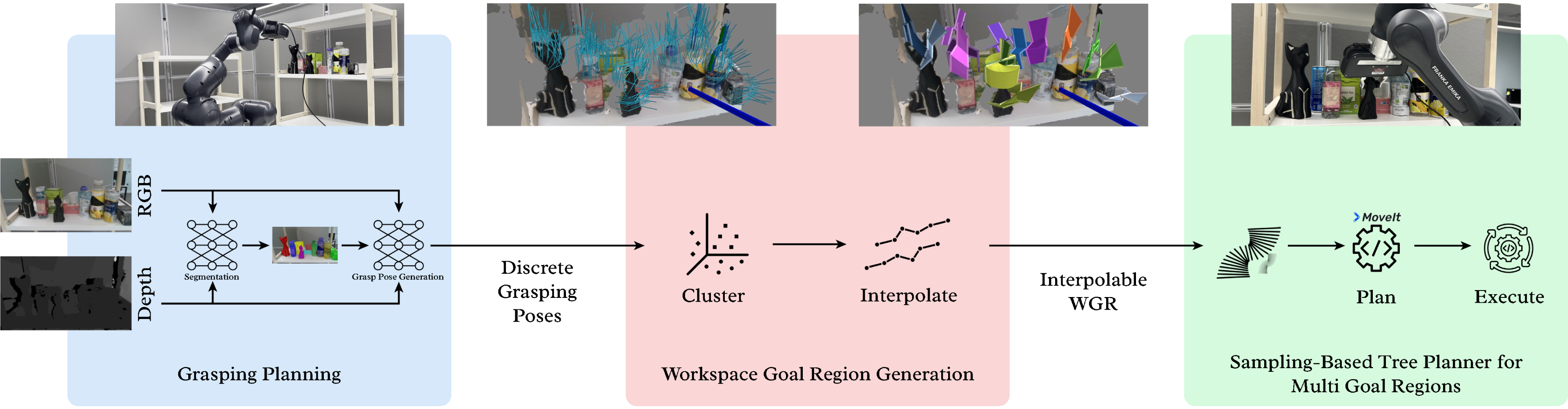
resulting in inefficient searches. To address this, we propose a pipeline
that integrates the capabilities of a grasp planner and motion planner to
jointly solve manipulation tasks. Our approach proposes to explicitly
represent the objects’ grasp affordances through continuous workspace
goal regions (WGRs), which can approximate the goal regions (GRs) that
are implicitly defined in the configuration space (C-Space). The result of
doing this is an extended start-to-goal motion planning problem, which is
solved with a sampling-based tree planner. Our pipeline not only
improves the accuracy of grasping in complex environments but also
significantly increases the success rate of manipulation tasks that involve
pick and place operations in such settings. We validate the effectiveness
of our approach through both simulation and real-robot experiments
using the Franka Emika robotic manipulator.